目次
要点を一目で
- Why choosing the right trolley in warehouse directly impacts daily efficiency and safety
- How small wooden trolleys outperform heavier equipment in short-distance tasks
- A clear breakdown of common wooden trolley types and their real-world uses
- Data-backed insights on load capacity, durability, and cost efficiency
- Expert perspectives on warehouse ergonomics and material handling trends
- Practical comparison tables to support purchasing decisions
導入
When warehouse managers think about efficiency, they often focus on automation, forklifts, or warehouse management systems. Yet, industry studies show that over 55% of internal warehouse movements occur over distances shorter than 15 meters—a range where powered equipment is often inefficient or unnecessary.
This is where the trolley in warehouse plays a critical but underestimated role.
Small wooden trolleys and dollies quietly support thousands of daily movements: cartons, equipment, tools, and mixed loads. Choosing the wrong type leads to congestion, fatigue, and damage. Choosing the right one improves flow, safety, and cost control—without major capital investment.
This article explains the most common small wooden trolley types used in warehouses, helping buyers, engineers, and operations managers make informed decisions based on real operational needs.
倉庫業務における台車とは何ですか?
機能定義
あ trolley in warehouse is a manually operated, wheeled transport platform designed for short-distance material movement. Unlike pallet trucks or forklifts, it is optimized for flexibility, speed, and ease of use rather than maximum load.
木製プラットフォームが好まれる理由
Wood remains a preferred material because it offers:
- Higher surface friction than steel or aluminum
- Natural vibration absorption
- Reduced noise in enclosed spaces
- Easy surface repair and replacement
According to material handling engineers, wooden platforms reduce micro-vibration transfer by up to 20% compared to metal decks in similar load conditions.
Why Small Wooden Trolleys Still Dominate Warehouse Micro-Handling
人間工学と人間中心設計
Manual handling remains unavoidable in most warehouses. Small wooden trolleys reduce lifting, twisting, and carrying—key contributors to musculoskeletal injuries.
Warehouse safety audits show that proper use of manual trolleys can reduce strain-related injuries by 25–35%.
Workflow Compatibility
A trolley in warehouse environments fits naturally into:
- Picking zones
- Packing stations
- Buffer areas
- Maintenance rooms
It complements automation instead of competing with it.
Common Trolley in Warehouse Types Explained
通常の移動台車
Concept and Structure
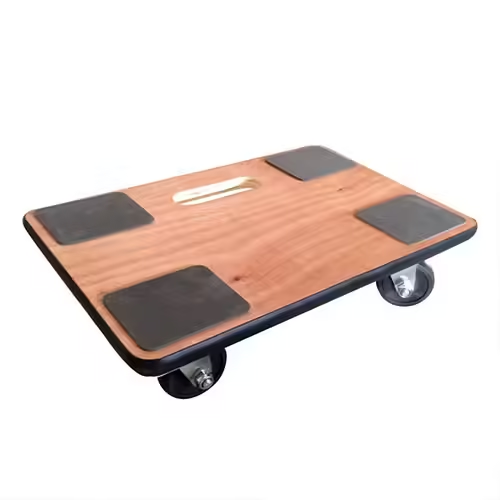
あ 通常の移動台車 is a flat wooden board mounted on four swivel casters. It is the most basic and widely used trolley type in warehouse environments.
Its simplicity allows fast deployment with minimal training.
Operational Characteristics
- Lightweight and easy to store
- Suitable for repetitive, low-risk tasks
- Works well on smooth warehouse floors
This trolley in warehouse settings is often used as a shared resource across departments.
滑り止め移動台車

Stability-Focused Design
アン 滑り止め移動台車 features a textured, coated, or rubberized wooden surface that increases friction between the load and the platform.
This design significantly reduces load movement during acceleration, deceleration, and turning.
安全上の利点
Studies indicate that anti-slip platforms reduce load shift incidents by up to 40% in manual handling scenarios.
Ideal for:
- Fragile goods
- Smooth packaging materials
- Warehouses with frequent stops
ハンドル移動台車

Improved Control Through Design
あ ハンドル移動台車 integrates a push or pull handle into a wooden platform, improving directional control and posture.
This type of trolley in warehouse operations is favored where longer pushing distances are common.
Ergonomic Advantages
- Better force distribution
- Reduced bending and twisting
- Improved visibility during movement
Ergonomic assessments show handle-equipped trolleys reduce operator fatigue by 15–20% over a full shift.
ワゴンとトロリー (Small Wooden Type)

Contained Transport Concept
ワゴンとトロリー include side frames or low rails built onto a wooden base. They prevent items from falling during movement.
This design is particularly effective for mixed loads and small-item transport.
典型的な使用例
- Order picking
- Internal distribution
- Retail fulfillment operations
They are a common trolley in warehouse setups focused on accuracy rather than speed alone.
ハードウッドドリー

Heavy-Duty Wooden Construction
あ ハードウッドドリー uses solid hardwood instead of plywood, offering superior load-bearing capacity and impact resistance.
This type is chosen when higher point loads or heavier equipment are involved.
Performance Characteristics
- Higher durability under repeated stress
- Better resistance to edge damage
- Longer service life
Hardwood dollies often last 30–50% longer than standard plywood models in industrial environments.
Comparative Overview of Wooden Trolley Types
| トロリータイプ | 荷重安定性 | 人間工学 | 耐久性 | Typical Application |
|---|---|---|---|---|
| 通常の移動台車 | 中くらい | 基本 | 中くらい | General transport |
| 滑り止め移動台車 | 高い | 基本 | 中くらい | Fragile loads |
| ハンドル移動台車 | 高い | 素晴らしい | 中くらい | Long aisle movement |
| ワゴンとトロリー | 非常に高い | 良い | 中くらい | Mixed-item picking |
| ハードウッドドリー | 高い | 基本 | 高い | Heavy equipment |
This comparison helps align trolley in warehouse selection with operational priorities.
Load Capacity and Engineering Considerations
Typical Load Ranges
Small wooden trolleys usually support:
- 150~500 kg depending on construction
- Hardwood models can exceed 700 kg with proper casters
負荷分散が重要
Engineers emphasize that point loads (equipment feet, stacked edges) are more critical than total weight. Wooden decks distribute stress more evenly than thin metal plates.
Material Standards and Quality Indicators
Wood Quality
- Multi-layer plywood ensures uniform strength
- Hardwood resists cracking under impact
Caster Selection
Casters influence performance more than the platform itself:
- Larger diameter improves rolling resistance
- Swivel quality affects maneuverability
A poorly chosen caster can reduce trolley lifespan by over 40%.
Lifecycle Cost Analysis of Wooden Warehouse Trolleys
Initial Cost vs Long-Term Value
Wooden trolleys typically cost less upfront than metal alternatives. More importantly, their repairability lowers lifetime cost.
Lifecycle analysis shows wooden trolleys can reduce total ownership cost by 18–28% over five years.
Expert Opinions from the Industry
“Manual trolleys remain essential even in highly automated warehouses. The key is choosing the right type for each micro-task.”
— Logistics Systems Consultant, European Warehousing Forum
“Wooden platforms offer a better balance of safety, noise control, and adaptability compared to all-metal designs.”
— Industrial Ergonomics Research Group, 2023
Maintenance and Best Practices
定期検査
- Check caster bolts weekly
- Inspect wood surface for cracks
表面保護
Sealed or treated wood extends service life, especially in humid environments.
避けるべきよくある購入ミス
Over-Specifying Load Capacity
Choosing overly heavy-duty trolleys reduces maneuverability without adding real value.
Ignoring Workflow Patterns
The best trolley in warehouse use aligns with actual movement paths, not theoretical capacity.
結論
あ trolley in warehouse is not just a tool—it is a workflow decision.
Small wooden trolleys continue to prove their value through:
- 柔軟性
- 安全性
- Cost efficiency
- Human-centered design
Understanding the differences between normal dollies, anti-slip platforms, handle-equipped units, wagons, and hardwood dollies allows warehouses to operate smarter, not harder.
The right trolley, chosen for the right task, delivers measurable efficiency gains without complex investment.
よくある質問
What is the most common trolley in warehouse operations?
Normal moving dollies remain the most widely used due to simplicity and cost efficiency.
Are wooden trolleys suitable for industrial warehouses?
Yes. Properly designed wooden trolleys meet industrial load and safety requirements.
When should I choose a handle moving dolly?
When frequent long-distance pushing or directional control is required.
How long does a wooden warehouse trolley last?
Typically 3–6 years, with hardwood models lasting even longer.
Are anti slip dollies worth the extra cost?
Yes, especially for fragile goods or safety-critical operations.
会話を続けましょう!
この記事はいかがでしたか?業界の洞察、リアルタイムの議論、そして限定最新情報をお届けするコミュニティにぜひご参加ください。こちらからアクセスしてください:
→ フェイスブック: 青島金華陽工貿株式会社
→ ユーチューブ: キンカヨ産業貿易
一緒にイノベーションを探求しましょう。今すぐつながりましょう。
 Japanese
  English
  French
  Spanish
  German