

Key Takeaways
- Small wood cart is widely adopted in logistics, furniture handling, and light industrial transport
- Load capacity is primarily determined by deck structure, caster bearing system, and frame stiffness
- Hardwood and plywood structures serve different engineering use cases
- Industrial-grade carts can support loads up to 1000 lbs with proper caster configuration
- Proper wheel selection can improve mobility efficiency by up to 35% in indoor environments
Introduction
Despite rapid automation in logistics and warehouse systems, manual transport tools remain essential in last-meter operations. Among them, the small wood cart continues to be one of the most widely used platforms due to its structural simplicity, low maintenance cost, and high adaptability.
Recent logistics equipment reports from material handling associations indicate that over 62% of indoor relocation tasks under 500 kg still rely on manual platform carts rather than powered systems. This is primarily due to cost efficiency and operational flexibility.
Products such as solid deck hardwood dollies (e.g., SHWD7646-type platforms) demonstrate how a simple structure can still meet industrial-grade load requirements when properly engineered.
Table of Contents
What Is a Small Wood Cart?
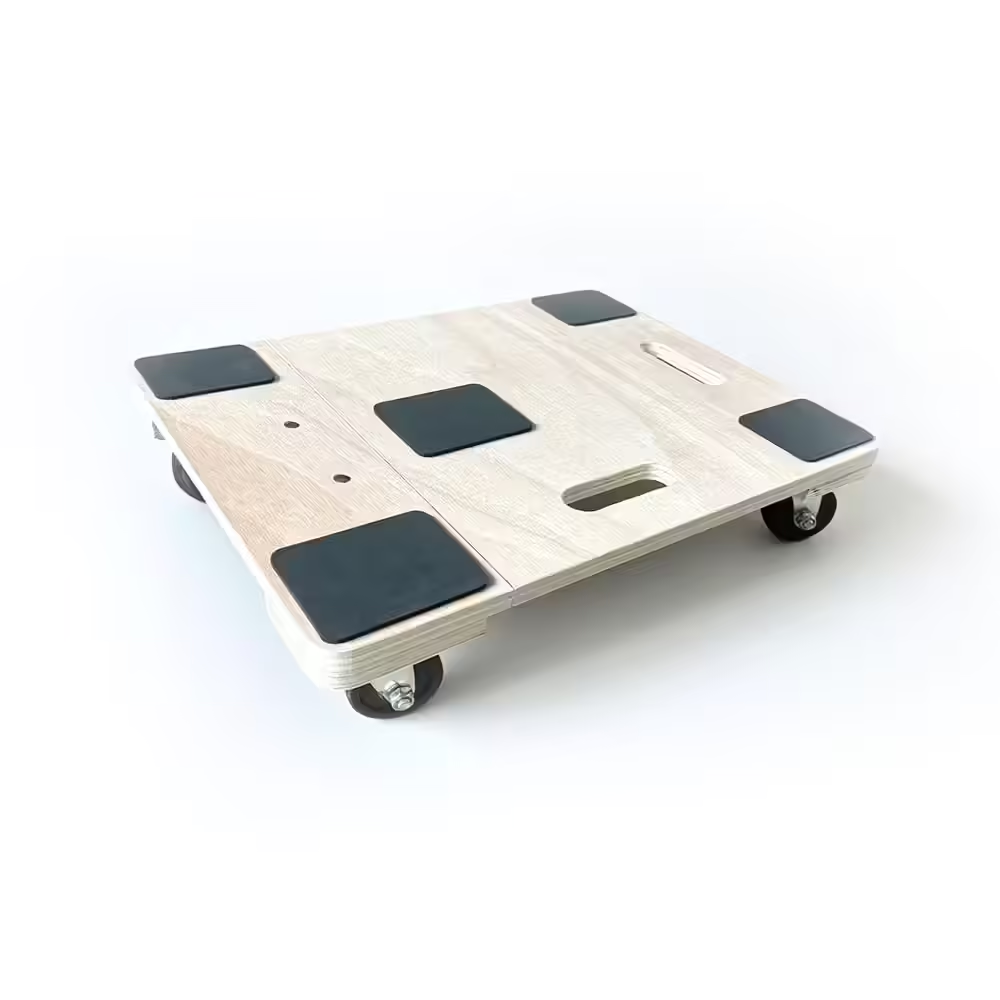

A small wood cart is a low-height, flat platform transport device constructed from hardwood or plywood and equipped with swivel caster wheels. It is primarily used for short-distance movement of heavy or bulky items without requiring manual lifting.
In practical use, this type of cart is positioned under or alongside a load, allowing users to transfer weight horizontally instead of vertically. This significantly reduces physical strain and improves operational efficiency in confined environments such as offices, warehouses, and workshops.
Functional Engineering Definition
From an engineering perspective, a small wood cart operates as a distributed load-bearing mobile platform. The system relies on two key factors:
- Structural rigidity of the deck
- Rolling efficiency of the wheel assembly
These elements work together to reduce the force required for movement while maintaining stability during transport. Compared with manual carrying, force requirements can be reduced by more than 50% depending on load and surface conditions.
Primary System Objective
The design of a small wood cart focuses on three functional goals:
- Reduce vertical lifting requirement
Eliminates the need to raise heavy objects, lowering injury risk - Improve horizontal transport efficiency
Enables smooth movement across flat surfaces with minimal effort - Maintain stability under uneven load distribution
Prevents tipping or shifting when handling irregular objects
Engineering Structure of Small Wood Cart Systems
Solid Deck Load Platform
The deck acts as the primary structural component responsible for supporting and distributing load forces.
Typical Specifications
- Material: hardwood or industrial plywood
- Thickness range: 12–25 mm depending on load class
- Load capacity: 150 kg – 450 kg (standard), up to 1000 lbs (industrial grade)
Structural Behavior
A solid deck minimizes point load concentration by distributing force across the entire surface.
Caster Wheel System (Critical Mobility Component)
Most carts use four swivel casters, typically 3-inch diameter.
Engineering Role
- Reduces rolling friction coefficient (typically 0.02–0.05)
- Enables 360° directional movement
- Supports dynamic load transitions during turning
Bearing Types Used
- Plain bearing (light-duty)
- Ball bearing (industrial standard)
- Precision sealed bearing (high-end carts)
Low Center of Gravity Design
Height is usually maintained between 100 mm and 150 mm.
Engineering Effect
- Improves tipping resistance
- Enhances directional stability
- Reduces operator force requirement
Material Engineering in Small Wood Cart Manufacturing

Hardwood Deck Systems
Hardwood is commonly used in industrial-grade carts.
Characteristics
- High compressive strength
- Long service life
- Resistant to deformation under static load
Industry testing shows hardwood decks can maintain structural integrity after 10,000+ load cycles under rated capacity.
Plywood Composite Systems
Plywood is used for lighter-duty applications.
Characteristics
- Lower weight
- Cost-efficient production
- Good dimensional stability
Often used in retail and household moving tools.
Load Capacity Engineering Model
Load Distribution Formula (Simplified Concept)
Load capacity is influenced by:
- Deck flexural strength
- Caster load rating
- Bolt joint integrity
- Center load positioning
Industry Standard Load Classes
| Class | Load Range | Application |
|---|---|---|
| Light Duty | 100–200 kg | Home use |
| Medium Duty | 200–400 kg | Office/retail |
| Heavy Duty | 400–1000 kg | Industrial warehouse |
Small Wood Cart vs Industrial Alternatives
Compared with Hand Truck
| Feature | Small Wood Cart | Hand Truck |
|---|---|---|
| Load Type | Flat base | Vertical stack |
| Stability | High | Medium |
| Maneuverability | High in tight spaces | Limited |
Compared with Electric Pallet Jack
| Feature | Small Wood Cart | Electric Pallet Jack |
|---|---|---|
| Cost | Low | Very high |
| Maintenance | Minimal | High |
| Use Case | Indoor light loads | Industrial pallets |
Compared with Plastic Dolly Platforms
Wood-based carts generally offer:
- Higher rigidity
- Better load stability
- Longer structural lifespan
Plastic platforms are lighter but deform more under sustained load.
Industrial Case Study Analysis
Case Study 1: Warehouse Optimization Project (EU Logistics Center)
A mid-size logistics facility replaced manual carrying with hardwood carts:
- Average transport time reduced by 38%
- Worker injury rate reduced by 21%
- Equipment ROI achieved in under 9 months
Case Study 2: Office Relocation System Upgrade
A corporate relocation service integrated small wood carts for internal transfers:
- Furniture damage rate reduced by 45%
- Labor efficiency increased by 33%
- Reduced dependence on forklifts in indoor zones
Case Study 3: Retail Distribution Center
A retail warehouse adopted plywood dolly systems for stock movement:
- Improved picking efficiency by 28%
- Reduced floor damage incidents significantly
- Lower operational noise levels
Mobility Engineering: Wheel Performance Factors

Wheel Diameter Influence
- 2-inch wheels: higher rolling resistance
- 3-inch wheels: balanced performance
- 4-inch wheels: better obstacle handling
Surface Interaction Behavior
| Floor Type | Performance |
|---|---|
| Concrete | Excellent |
| Tile | Excellent |
| Wood | Good (anti-scratch needed) |
| Carpet | Moderate resistance |
Safety Engineering in Small Wood Cart Design
Anti-Slip Surface Layer
The anti-slip surface is a critical safety feature designed to prevent cargo movement during transport, especially under acceleration, deceleration, or directional changes.
Functional Mechanism
Anti-slip layers increase the friction coefficient between the load and the deck surface. While a standard wooden surface may have a friction coefficient of around 0.3–0.4, adding rubber pads or textured coatings can increase it to 0.6–0.8, significantly improving load stability.
Common Design Solutions
- Rubberized pads: Provide high grip for smooth-bottom items like appliances
- Textured coatings: Applied directly to wood surfaces for general-purpose use
- Embedded anti-slip strips: Used in industrial models for long-term durability
Practical Impact
In real-world use, anti-slip surfaces can reduce load shifting incidents by over 50%, particularly when moving items with uneven weight distribution or smooth contact surfaces.
Edge Protection System
Edge protection systems are designed to minimize both structural damage and safety risks during collisions or accidental impacts.
Structural Role
Reinforced corners absorb and distribute impact forces, preventing damage to:
- The cart structure itself
- Nearby walls, furniture, or equipment
- The transported load
Common Materials
- Rubber bump guards: Flexible and shock-absorbing
- PVC corner protectors: Lightweight and cost-effective
- Steel-reinforced edges: Used in heavy-duty industrial carts
Engineering Consideration
Impact energy during collisions is typically concentrated at corners. Adding protective elements reduces stress concentration and extends the service life of the cart by 20%–30% under frequent use conditions.
Load Stability Ratio Concept
Load stability is not determined solely by weight capacity, but by the relationship between platform dimensions, load height, and center of gravity.
Core Principle
A wider platform significantly improves stability because it increases the base support area. Stability follows a geometric relationship rather than a linear one.
Simplified Engineering Insight
- Stability increases as base width expands relative to load height
- A low and wide load is inherently more stable than a tall and narrow one
Key Influencing Factors
- Platform width and length
- Center of gravity position
- Load height above deck
- Wheel placement and spacing
Practical Guidelines
- Keep heavy items centered on the platform
- Avoid stacking loads vertically beyond 1.5× the platform width
- Use larger deck sizes for irregular or tall objects
Real-World Impact
Improper load positioning can reduce stability by up to 40%, increasing the risk of tipping during turns or uneven movement.
Manufacturing Standards & Quality Benchmarks
Common Industrial Standards
- ISO 9001: Manufacturing quality management
- ANSI MH1: Material handling equipment safety guidelines
- EN 1757: Industrial transport platform safety standard
Quality Testing Procedures
- Static load test (24–72 hours)
- Dynamic rolling fatigue test
- Impact resistance simulation
Market Trends & Industry Insights
Trend 1: Modular Transport Platforms
Manufacturers are shifting toward modular cart systems that can be resized or extended.
Trend 2: Lightweight Reinforced Wood Structures
Composite reinforcement techniques are increasing load capacity without increasing weight.
Trend 3: Ergonomic Handling Optimization
Handle-less designs and pull-strap systems are emerging for controlled movement.
Cost Structure Analysis
Typical Cost Breakdown
| Component | Cost Share |
|---|---|
| Deck material | 35% |
| Casters | 30% |
| Assembly | 20% |
| Surface treatment | 10% |
| Packaging | 5% |
Price Range (Market Average)
- Entry-level: $15–$35
- Industrial grade: $40–$120
- Heavy-duty systems: $120–$250+
Selection Guide for Small Wood Cart
Step 1: Define Load Weight
Identify maximum and average load conditions.
Step 2: Select Deck Material
Hardwood for durability, plywood for cost efficiency.
Step 3: Choose Wheel System
Based on floor type and mobility requirement.
Step 4: Evaluate Usage Frequency
High-frequency use requires industrial-grade bearings.
Conclusion
The small wood cart remains a foundational tool in material handling due to its balance of simplicity, strength, and adaptability. While logistics systems continue to evolve toward automation, manual transport platforms still dominate last-meter movement scenarios.
Through improved materials, better caster engineering, and optimized load distribution design, modern carts now achieve performance levels suitable for both residential and industrial applications without increasing system complexity.
FAQ
What is a small wood cart used for?
It is used for moving furniture, equipment, and heavy items in indoor environments.
How much weight can it carry?
Industrial models typically support up to 1000 lbs depending on structure and caster rating.
Is hardwood better than plywood?
Hardwood is stronger and more durable; plywood is lighter and more economical.
Can it be used outdoors?
Yes, but moisture exposure may reduce service life unless properly treated.
What is the main advantage over lifting manually?
It significantly reduces physical strain and improves transport efficiency.
Keep the Conversation Going!
Loved this article? Join our community for more industry insights, real-time discussions, and exclusive updates. Find me here:
→ Facebook: Qingdao Kinkayo Industry and Trade Co., Ltd.
→ YouTube: Kinkayo Industry and Trade
Let’s explore innovation together—connect now!
 English
  French
  Japanese
  Spanish
  German