Table of Contents
Introduction
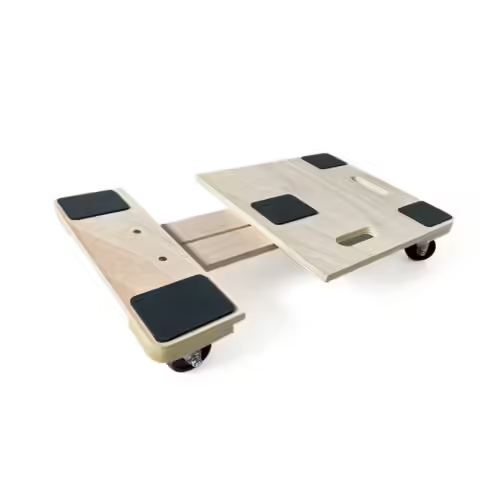
Warehouse efficiency depends heavily on how materials move between receiving, storage, picking, production, packing and outbound areas. While forklifts and automated systems handle many large-scale movements, a significant amount of daily warehouse transportation still relies on manually operated carts, dollies and trolleys.
Material handling carts are particularly useful for these short-distance movements because they can reduce repeated lifting and carrying while helping operators transport multiple items in a controlled way. However, choosing the right cart requires more than comparing load capacity. Platform dimensions, wheel material, caster configuration, aisle width, floor condition, handle design and the type of goods being moved all affect real-world performance.
This guide explains how to select material handling carts for different warehouse operations and how to match cart design to receiving, storage, picking, replenishment, production and shipping workflows.
Why Material Handling Carts Matter in Warehouses
Warehouses contain many types of material movement. Goods may travel only a few meters from a receiving pallet to an inspection table, or they may move repeatedly between storage racks, production stations and packing areas.
Using workers to manually carry these loads can create unnecessary physical effort, particularly when items are heavy, bulky or moved frequently.
The U.S. Occupational Safety and Health Administration identifies lifting, lowering, pushing and pulling heavy loads as important ergonomic risk factors in warehouse environments. OSHA also notes that appropriate equipment and workplace design can help reduce these risks. OSHA’s Warehousing Hazards and Solutions guidance provides additional information on ergonomic considerations in receiving, picking and other warehouse operations.
For warehouse managers, this makes cart selection part of both operational planning and workplace ergonomics.
The right equipment should reduce unnecessary handling while remaining easy to steer, load and control throughout the complete transport route.
Start With the Warehouse Material Flow
Before choosing a material handling cart, map how goods actually move through the facility.
A typical distribution warehouse might follow:
Receiving → Inspection → Putaway → Storage → Picking → Packing → Outbound Staging
A manufacturing facility may follow a different sequence:
Receiving → Raw Material Storage → Production → Work-in-Process Transfer → Finished Goods Storage → Shipping
Each stage creates different cart requirements.
A receiving cart may need to handle many different carton sizes. Picking carts usually require frequent stopping and turning. Production carts may repeatedly carry the same component between fixed locations. Outbound carts may need greater platform capacity for consolidated loads.
Choosing one cart for every task can therefore create compromises.
A more effective approach is to match equipment to each major material flow.
Material Handling Carts for Receiving Operations
Receiving areas often handle the widest variety of loads in the warehouse.
Incoming products may include cartons, containers, appliances, furniture, equipment and irregular packaged goods. A receiving cart should therefore provide enough flexibility to support different sizes without becoming unnecessarily difficult to maneuver.
Platform carts are useful in this environment because their open decks can support many types of packaged goods.
Low-profile dollies may be more appropriate when bulky objects need to be positioned close to the floor.
Before selecting equipment for receiving, consider:
- Maximum expected load
- Typical carton dimensions
- Receiving dock layout
- Doorway dimensions
- Travel distance
- Floor transitions
- Loading frequency
- Required turning space
The complete travel route matters.
A cart may roll smoothly inside the warehouse but become difficult to operate when crossing dock plates, elevator gaps or damaged concrete.
Choosing Carts for Storage and Putaway
Putaway transfers goods from receiving areas into their assigned warehouse storage locations.
For short-distance transport, manual material handling carts can provide a simple alternative to using powered equipment for every movement.
The main challenge is balancing load capacity with maneuverability.
A larger cart may transport more goods in one trip, but it also requires more turning space. In narrow warehouse aisles, a smaller cart may provide better control even if it requires additional trips.
Warehouse buyers should evaluate:
- Aisle width
- Storage rack spacing
- Turning radius
- Product dimensions
- Maximum stack height
- Operator visibility
- Floor condition
Visibility is particularly important when goods are stacked.
OSHA identifies pushing and pulling heavy loads, awkward posture and repetitive warehouse work among the ergonomic risk factors that should be controlled through appropriate workplace design and equipment. OSHA’s warehouse ergonomics guidance provides useful reference information for these situations.
Material Handling Carts for Warehouse Picking

Picking operations have different requirements because carts often stop, start and change direction many times during a single route.
A picking cart should therefore be easy to control rather than simply capable of carrying the maximum possible load.
Warehouse picking equipment should be selected according to:
| Selection Factor | Why It Matters |
|---|---|
| Aisle width | Determines cart width and turning space |
| Product size | Influences platform configuration |
| Route distance | Affects rolling resistance and operator effort |
| Stop frequency | Makes steering performance important |
| Load height | Influences visibility |
| Floor surface | Determines suitable wheels |
| Picking volume | Influences durability requirements |
| Storage space | Determines whether folding designs are useful |
The best cart for picking is therefore the one that supports the entire route efficiently.
A very large cart may reduce the number of trips but become difficult to navigate through congested aisles.
Platform Carts for General Warehouse Transport
Platform carts are among the most versatile material handling solutions because they provide an open supporting surface for cartons, containers, equipment and packaged products.
A dedicated handle can provide better directional control than a low-profile dolly, particularly when loads travel longer distances.
Easemovo offers a range of wagons and trolleys for commercial material movement applications.
Platform carts can be particularly useful for:
- Receiving
- Stock replenishment
- Internal warehouse transport
- Production transfer
- Maintenance operations
- Packing areas
- Outbound staging
When comparing platform carts, buyers should evaluate deck dimensions, structural design, wheel diameter, caster layout and floor compatibility together.
For applications where capacity is a major concern, Easemovo’s Heavy Duty Platform Cart Capacity Selection Guide explains how load requirements influence product selection.
Moving Dollies for Bulky Loads
Not every warehouse load requires a handled cart.
Low-profile moving dollies are often useful for furniture, appliances, large cartons and other bulky objects because the platform remains close to the floor.
This can simplify loading and help keep the center of gravity relatively low.
Typical warehouse applications include:
- Furniture movement
- Appliance handling
- Display fixtures
- Equipment relocation
- Large cartons
- Workshop machinery
- Finished components
Dollies can also offer excellent maneuverability when four swivel casters are used.
For delicate finished goods, carpeted or anti-slip surfaces may provide additional protection depending on the application.
Easemovo’s moving dolly range includes different platform configurations for general material handling requirements.
Why Wheel Selection Matters
Wheel design has a major influence on how easily a loaded cart moves.
The same platform can behave very differently depending on wheel material, diameter, bearing construction and caster configuration.
Warehouse floors may include:
- Smooth concrete
- Epoxy flooring
- Tile
- Rough concrete
- Expansion joints
- Dock plates
- Elevator gaps
- Thresholds
The UK’s Health and Safety Executive notes that floor condition, wheel condition and wheel suitability all affect the amount of force needed to push or pull wheeled equipment. HSE also recommends ensuring that wheels are suited to the flooring and operating environment. See the HSE guidance on pushing and pulling risk factors.
This means wheel selection should always be based on the complete route rather than a single section of warehouse floor.
Rubber, Polyurethane or Hard Wheels?
Different wheel materials provide different performance characteristics.
Rubber Wheels
Rubber wheels are often used where relatively quiet operation and floor protection are important.
They can be suitable for smooth indoor warehouse environments, furniture handling and commercial facilities.
Polyurethane Wheels
Polyurethane wheels are commonly used in industrial environments because they can provide a balance of durability, rolling performance and relatively quiet operation.
The exact result depends on tread hardness and wheel construction.
Hard Wheels
Hard plastic or nylon-type wheels can offer relatively low rolling resistance on smooth surfaces, but they may transmit more vibration on rough floors.
Recent HSE guidance on wheeled handling equipment also notes that wheel material affects rolling resistance and noise characteristics. HSE’s guidance on wheeled racks and heavy units discusses the practical differences between harder wheels, polyurethane and rubber options.
Wheel Diameter Affects Rolling Performance
Wheel diameter is another important selection factor.
Larger wheels generally pass over small floor irregularities, gaps and thresholds more easily than very small wheels.
This can make a significant difference in warehouses where carts repeatedly cross:
- Expansion joints
- Elevator gaps
- Door thresholds
- Dock transitions
- Uneven concrete
OSHA recommends using large, low-rolling-resistance wheels where carts must move over mixed flooring and gaps. More detail is available in OSHA’s ergonomic solutions for cart movement.
Smaller wheels can still be appropriate when maintaining a low platform height is important and floors are consistently smooth.
The ideal diameter therefore depends on the application.
Swivel Casters vs Fixed Casters
Caster layout determines how the cart behaves when turning.
Four swivel casters allow multidirectional movement and can provide excellent maneuverability inside narrow warehouse areas.
However, excessive swivel movement may make a cart harder to track along long straight routes.
A combination of fixed and swivel casters can provide greater directional stability.
This creates a simple rule:
Tight maneuvering usually favors greater swivel capability.
Long straight travel often benefits from directional stability.
Warehouse buyers should therefore consider the operating route before specifying caster layout.
Load Capacity Is Not the Only Specification

One of the most common purchasing mistakes is comparing carts only by rated capacity.
Capacity matters, but it does not describe the entire handling system.
A buyer should also examine:
- Load distribution
- Center of gravity
- Platform dimensions
- Wheel capacity
- Caster construction
- Travel distance
- Floor condition
- Frequency of use
Two loads weighing exactly the same can create completely different handling requirements.
A compact metal component may concentrate its weight over a small area, while large cartons distribute the weight across most of the platform.
The correct cart therefore needs to support both total weight and load geometry.
Handle Design and Ergonomics
Handles influence operator posture and control.
A poorly positioned handle may require excessive bending or reaching, especially when carts are moved repeatedly throughout the workday.
HSE recommends considering handle position in relation to the worker and notes that hand positions between approximately hip and shoulder height are generally more comfortable for pushing and pulling tasks. See HSE’s push-pull ergonomics guidance.
OSHA similarly recommends keeping push handles around waist-to-chest height where appropriate. OSHA’s cart ergonomics recommendations also emphasize equipment maintenance and appropriate wheel selection.
For warehouse fleets used by many operators, handle design should therefore be evaluated as part of the overall ergonomics of the equipment.
Push or Pull?
Where cart design and working conditions allow, pushing is often preferred over pulling.
HSE advises workers using wheeled handling equipment to push rather than pull where possible because this is generally better ergonomically. HSE’s guidance for wheeled handling equipment also recommends keeping loads low enough to maintain visibility and paying attention to ramps and uneven surfaces.
The preferred direction may still depend on:
- Load shape
- Cart configuration
- Available space
- Slope
- Turning requirements
This is another reason why equipment should be evaluated within the actual warehouse route instead of in isolation.
Folding Carts for Limited Storage Space
Warehouses must consider the space carts occupy when they are not being used.
A large fleet of fixed-handle carts can consume valuable floor area.
Folding platform carts can help reduce this storage footprint by allowing handles to collapse.
They are particularly useful in:
- Small warehouses
- Retail stockrooms
- Delivery vehicles
- Temporary facilities
- Service operations
- Multi-use workspaces
Buyers should still evaluate the durability of hinges and locking mechanisms because repeated folding introduces additional moving components.
The feature should provide a genuine workflow benefit rather than simply adding complexity.
Material Handling Carts for Production Areas
Manufacturing facilities often use carts to transfer components between storage, assembly, inspection and packaging.
These routes can be highly repetitive.
A purpose-designed cart may therefore improve workflow more effectively than a generic platform.
Important considerations include:
- Workstation height
- Component dimensions
- Batch quantity
- Loading direction
- Route width
- Frequency of transport
- Required containment
- Surface protection
When the same components move repeatedly between fixed stations, customization may be worth considering.
Easemovo provides custom material handling solutions for applications requiring different dimensions, materials, caster configurations or structural designs.
When Custom Material Handling Carts Make Sense
Standard products cover many warehouse applications, but not every material flow is standard.
Custom carts become particularly useful when:
The cargo has unusual dimensions.
Long panels, oversized assemblies or irregular equipment may need additional support.
Warehouse aisles have strict width limits.
A custom platform size may improve maneuverability.
The same cargo moves repeatedly.
A dedicated cart can be designed around the load instead of forcing operators to adapt a general-purpose platform.
Floor conditions require specific wheels.
Caster material, diameter or layout may need modification.
The equipment is intended for distribution or private labeling.
Branding, color, packaging and configuration may need to follow defined specifications.
A properly specified custom cart should solve a real operational requirement rather than simply differ visually from a standard product.
Material Handling Carts and Warehouse Ergonomics
Material handling equipment is often introduced to reduce lifting, but poor cart selection can still create demanding pushing and pulling tasks.
The amount of effort required depends on multiple factors, including:
- Total load
- Cart weight
- Wheel condition
- Handle height
- Floor surface
- Route length
- Obstacles
- Gradients
- Frequency
HSE’s RAPP assessment tool for pushing and pulling operations is specifically designed to help workplaces identify risks associated with moving loads using wheeled equipment such as carts, trolleys and similar devices.
The guidance highlights an important principle: simply putting a heavy object on wheels does not automatically remove all ergonomic risk.
Equipment condition and working environment still matter.
Why Cart Maintenance Matters
A material handling cart that performs well when new can gradually become more difficult to move if maintenance is ignored.
Common problems include:
- Damaged caster bearings
- Worn wheel treads
- Wrapped debris
- Loose fasteners
- Bent handles
- Structural damage
- Inoperative brakes
HSE specifically recommends maintaining wheels and castors and using an effective equipment maintenance program. HSE’s guidance on pushing and pulling loads emphasizes that poorly maintained wheeled equipment can increase handling difficulty.
For high-use warehouse fleets, inspection should therefore be scheduled rather than performed only after equipment becomes difficult to operate.
Common Warehouse Cart Selection Mistakes
One of the biggest mistakes is assuming that one cart can efficiently perform every warehouse task.
Receiving, picking, production transfer and bulky-load handling can have very different requirements.
Another common mistake is over-specifying capacity.
A cart with a very high load rating may also be larger, heavier or less maneuverable than necessary.
Other frequent mistakes include:
- Ignoring aisle dimensions
- Choosing wheels without evaluating floors
- Stacking goods too high
- Ignoring operator visibility
- Selecting a large deck for small loads
- Failing to inspect caster condition
- Using four swivel casters where directional stability is needed
- Ignoring empty-cart storage
- Selecting products only by appearance
A workflow-based purchasing process avoids many of these problems.
How to Build a Warehouse Cart Fleet
Larger facilities often perform better with several cart types rather than one universal model.
A practical equipment mix might include:
| Warehouse Operation | Suitable Equipment | Main Priority |
|---|---|---|
| Receiving | Platform cart | Flexible load handling |
| Putaway | Compact trolley | Maneuverability |
| Picking | Picking/platform cart | Frequent steering |
| Replenishment | Platform trolley | Capacity and control |
| Furniture handling | Moving dolly | Low platform height |
| Production transfer | Custom cart | Repeatable workflow |
| Packing | Platform cart | Accessibility |
| Outbound staging | Heavy-duty cart | Load capacity |
This approach allows equipment to match the task while still maintaining reasonable standardization across the warehouse.
What B2B Buyers Should Ask a Manufacturer
When purchasing material handling carts for warehouse fleets, distribution or OEM programs, buyers should evaluate both the product and the manufacturing capability behind it.
Useful questions include:
- What is the rated load capacity?
- What platform dimensions are available?
- What caster materials can be supplied?
- What wheel diameters are available?
- Can fixed and swivel configurations be changed?
- Can handles be modified?
- Can platform dimensions be customized?
- How are carts inspected?
- Can colors or branding be customized?
- Are replacement wheels available?
- Can prototypes be developed for special applications?
These questions help transform a general product inquiry into a clear technical specification.
Frequently Asked Questions
What are material handling carts used for?
Material handling carts transport cartons, components, equipment, furniture and other goods between warehouse receiving, storage, picking, production, packing and shipping areas.
What is the best cart for warehouse use?
There is no single best design. Platform carts work well for general transportation, moving dollies can suit bulky loads, and specialized carts may be better for picking or production applications.
How much capacity should a warehouse cart have?
The cart should comfortably handle the heaviest expected working load without exceeding the manufacturer’s rated capacity. Load dimensions and weight distribution should also be considered.
Are larger wheels better?
Larger wheels can generally move over gaps and uneven surfaces more easily, although they can increase overall platform height. The correct diameter depends on floor conditions.
Should warehouse carts have swivel casters?
Swivel casters improve maneuverability. Fixed casters can improve directional tracking. Many applications use a combination depending on route requirements.
What wheel material is best for warehouse carts?
The appropriate material depends on floor type, noise requirements, rolling resistance and load conditions. Rubber, polyurethane and harder wheel materials each suit different applications.
Can material handling carts be customized?
Yes. Depending on the manufacturer, dimensions, platform structure, handles, casters, wheel materials, branding and other features can be adapted for specific applications.
Why is cart maintenance important?
Damaged or poorly maintained wheels and casters can increase rolling resistance and operator effort. Regular inspections help maintain predictable movement and equipment condition.
Conclusion
Choosing material handling carts for warehouse operations is not simply a matter of selecting the strongest platform available.
The equipment should match the complete material flow.
Receiving areas require flexibility. Picking operations require maneuverability. Long warehouse routes need predictable steering and good rolling performance. Bulky goods may benefit from low-profile dollies, while repetitive production processes may justify customized carts.
Platform size, load capacity, wheel diameter, caster layout, handle position, floor condition and travel distance should therefore be evaluated together.
For warehouses that use multiple handling processes, combining several cart types is often more effective than relying on one general-purpose design.
Easemovo provides moving dollies, platform carts, wagons, trolleys and customized material handling equipment for warehouse, logistics and industrial applications.
Need the Right Material Handling Cart for Your Warehouse?
Choosing the correct cart starts with understanding the load, floor, route and operating frequency.
Explore Easemovo’s material handling equipment range or contact Easemovo to discuss warehouse carts, moving dollies and customized material handling solutions.
 English
  French
  Japanese
  Spanish
  German