

Introduction
In today’s fast-paced logistics and warehousing industry, efficiency is everything. From order picking speed to worker safety, every small improvement can translate into significant cost savings and higher customer satisfaction. One often overlooked yet critical piece of equipment is the platform cart.
A well-designed platform cart is not just a simple transport tool—it is a productivity multiplier. Whether you are running a high-volume distribution center, a retail warehouse, or a manufacturing facility, selecting the right platform cart can reduce labor costs, minimize injuries, and streamline workflows.
With the global warehouse automation and material handling market continuing to grow (projected to exceed $50 billion in the coming years), businesses are increasingly focusing on optimizing manual handling tools like the platform cart to complement automated systems.
Key Takeaways:
- Platform cart solutions significantly improve warehouse efficiency and workflow
- Load capacity, material, and wheel type are critical selection factors
- Foldable platform cart designs help optimize storage space
- Comparing platform cart vs dolly helps clarify use cases
- Ergonomics and safety features reduce workplace injuries
- Real-world applications highlight measurable productivity gains
- Industry standards and testing ensure long-term reliability
Table des matières
Qu'est-ce qu'un Chariot à plateforme in Warehouse Operations?
Platform Cart Definition
UN platform cart is a flatbed material handling tool equipped with wheels and a handle, designed to transport goods across short to medium distances. It is widely used in warehouses, factories, and retail environments.
Core Function in Modern Logistics
In warehouse operations, a platform cart serves as a bridge between manual labor and automation. It enables efficient movement of goods without requiring complex machinery.
Evolution of Platform Cart Design
Over the past two decades, platform cart designs have evolved significantly:
- From simple wooden decks to reinforced steel structures
- From fixed wheels to 360-degree swivel casters
- From bulky frames to foldable and space-saving designs
Key Types of Platform Cart for Warehouses
Folding Platform Cart
A folding platform cart is designed for compact storage and easy transport. It is particularly useful in warehouses where space optimization is critical.
Heavy Duty Platform Cart
Heavy-duty platform carts are engineered for industrial applications. They typically feature steel frames and can support loads up to 1000 kg or more.
Wooden Deck Platform Cart
Wooden deck carts provide a stable and cushioned surface, making them ideal for transporting fragile or irregularly shaped items.
Utility Platform Cart
Utility platform carts offer versatility and are suitable for mixed-use environments such as warehouses, retail stores, and workshops.
How to Choose the Best Platform Cart for Warehouses

Load Capacity Considerations
Selecting the correct load capacity is essential. Overloading a platform cart can lead to equipment failure and workplace accidents.
Typical capacity ranges:
- Light-duty: 150–300 kg
- Medium-duty: 300–600 kg
- Heavy-duty: 600–1000 kg+
Wheel Type and Performance
Wheel selection directly affects performance:
- Pneumatic wheels: absorb shocks on uneven surfaces
- Solid rubber wheels: durable and maintenance-free
- Polyurethane wheels: quiet and floor-friendly
Matériel de la plateforme
The platform material determines durability and suitability:
- Steel: maximum strength and durability
- Wood: shock absorption and versatility
- Rubber-coated: anti-slip protection
Conception ergonomique
Ergonomics plays a crucial role in reducing worker fatigue. Features like padded handles, optimal height, and smooth steering improve usability.
Platform Cart vs Dolly: Which Is Better?
| Fonctionnalité | Chariot à plateforme | Chariot de déménagement |
|---|---|---|
| Structure | Flat platform with handle | Flat base without handle |
| Capacité de charge | Medium to heavy | Léger à moyen |
| Maniabilité | Easy steering | Requires bending or pulling |
| Utilisation optimale | Warehouse logistics | Furniture moving |
| Stockage | Foldable options available | Compact and low-profile |
Practical Selection Insight
For continuous warehouse operations, a platform cart is the better choice due to its ergonomic design and higher efficiency. Dollies are more suitable for occasional or specialized tasks.
Real Warehouse Applications of Platform Cart
Inventory Handling
Platform carts are widely used to move goods between storage racks and loading areas. They reduce handling time and improve throughput.
Order Picking
Workers can collect multiple items in a single trip using a platform cart, significantly improving picking efficiency.
Equipment Transport
Heavy machinery parts and tools can be transported safely, reducing manual lifting risks.
Case Study: Improving Warehouse Efficiency with Platform Cart
Arrière-plan
A mid-sized logistics company handling over 5,000 daily orders experienced delays due to inefficient manual handling.
Solution
The company introduced heavy-duty folding platform carts with optimized wheel systems.
Results
- 30% reduction in order picking time
- 25% decrease in worker fatigue complaints
- 15% improvement in overall operational efficiency
Example: Efficient Folding Platform Cart Solution
TC1860 Folding Platform Cart Aperçu
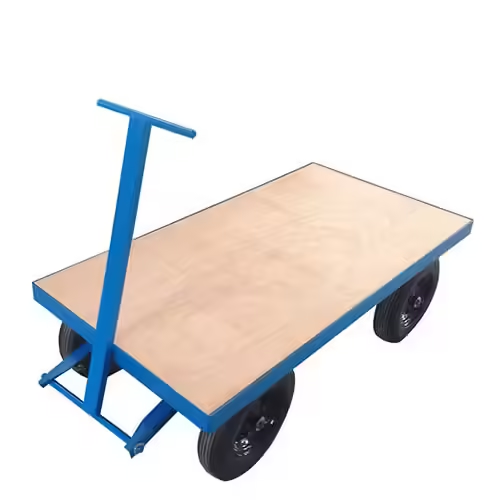
The TC1860 folding platform cart is designed for demanding warehouse environments. It supports loads from 150 kg to 1 ton.
Caractéristiques principales
- Foldable design for compact storage
- Heavy-duty steel frame for durability
- Multiple wheel options for different surfaces
- Ergonomic handle for easy control
Application Advantages
This platform cart enhances flexibility and efficiency, making it ideal for warehouses, factories, and retail operations.
Industry Standards and Safety Guidelines
OSHA Recommendations
According to OSHA guidelines:
- Workers should avoid excessive manual lifting
- Proper equipment like platform carts should be used for heavy loads
ISO Standards for Material Handling Equipment
Platform carts should meet ISO standards for:
- Load testing
- Stability
- Durabilité
Safety Best Practices
- Always check load limits before use
- Ensure wheels are in good condition
- Avoid uneven load distribution
Advanced Features in Modern Platform Cart Design
Anti-Slip Surfaces
Rubber-coated platforms prevent goods from sliding during transport.
Noise Reduction Wheels
Polyurethane wheels reduce noise, making them suitable for indoor environments.
Conception modulaire
Some platform carts allow interchangeable components for different applications.
Smart Integration Trends
With the rise of smart warehouses, some platform carts are being integrated with tracking systems and sensors.
Comparing Platform Cart Materials and Performance
| Matériel | Strength | Poids | Coût | Cas d'utilisation la meilleure |
|---|---|---|---|---|
| Acier | Haut | Lourd | Moyen | Industrial warehouses |
| Aluminium | Moyen | Lumière | Haut | Mobile operations |
| Bois | Moyen | Moyen | Faible | General-purpose transport |
| Rubber-coated | Haut | Moyen | Moyen | Fragile goods handling |
Maintenance Tips for Long-Term Use

Inspection régulière
Check wheels, handles, and platform integrity regularly to ensure safe operation.
Cleaning and Lubrication
Keep wheels clean and lubricated to maintain smooth movement.
Gestion de la charge
Avoid exceeding the rated capacity to extend the lifespan of the platform cart.
Emerging Trends in Warehouse Material Handling
Integration with Automation
Platform carts are increasingly used alongside automated systems such as conveyors and robots.
Sustainability Focus
Manufacturers are using recyclable materials and eco-friendly coatings.
Customization Demand
Businesses are seeking customized platform cart solutions tailored to specific workflows.
FAQ
What is the ideal load capacity for a warehouse platform cart?
Most warehouses require a platform cart with a load capacity between 300 kg and 1000 kg depending on operational needs.
Is a folding platform cart better for small warehouses?
Yes, folding designs save space and improve storage efficiency.
What wheels are best for a warehouse platform cart?
Solid or polyurethane wheels are ideal for smooth indoor floors, while pneumatic wheels suit rough surfaces.
How often should a platform cart be maintained?
Routine checks should be performed weekly, with detailed inspections monthly.
Can a platform cart improve warehouse productivity?
Yes, studies show that proper material handling tools can improve productivity by up to 30%.
Conclusion
Selecting the best platform cart for warehouses is a strategic decision that impacts efficiency, safety, and cost-effectiveness. By understanding key factors such as load capacity, material, wheel type, and application scenarios, businesses can choose the right platform cart to optimize their operations.
As warehouses continue to evolve with automation and digitalization, the role of the platform cart remains essential—providing a reliable, flexible, and cost-effective solution for material handling across industries.
Continuez la conversation !
Vous avez aimé cet article ? Rejoignez notre communauté pour plus d'informations sur le secteur, des discussions en temps réel et des actualités exclusives. Retrouvez-moi ici :
→ Facebook: Qingdao Kinkayo Industrie et Commerce Co., Ltd.
→ YouTube : Industrie et commerce de Kinkayo
Explorons ensemble l’innovation – connectez-vous maintenant !
 French
  English
  Japanese
  Spanish
  German