

Choosing between a hardwood dolly and a plywood dolly is not simply a matter of selecting the material that sounds stronger. Deck construction, caster size, load distribution, surface protection, operating environment, and frequency of use can all have a greater influence on real-world performance.
For warehouses, furniture moving, workshops, offices, logistics operations, and general material handling, both designs can be practical. The better option depends on what will be moved, how often the dolly will be used, and the conditions under which it will operate.
Key takeaways:
- A hardwood dolly is particularly suitable when a rigid platform, repeated handling, and durable structural support are priorities.
- A plywood dolly provides a stable engineered panel that can be configured in different sizes and surface designs.
- Hardwood does not automatically mean that every hardwood dolly has a higher rated capacity than every plywood model.
- Caster capacity, deck dimensions, fasteners, frame construction, and load distribution must be evaluated together.
- Carpet, rubber, anti-slip pads, bump guards, and wheel materials can be just as important as the deck itself.
- The best choice should be based on the complete moving system rather than deck material alone.
What Is a Hardwood Dolly?
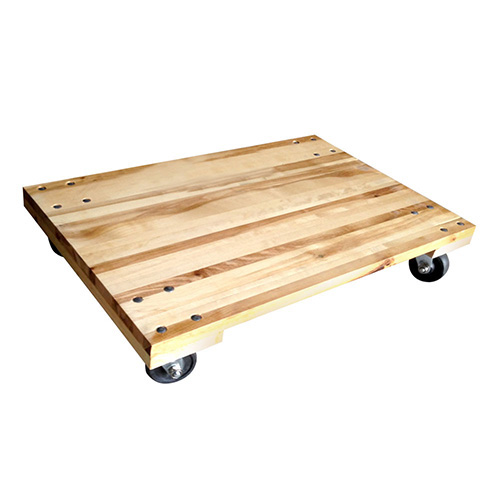
A hardwood dolly is a low-profile material handling platform that uses solid hardwood components as the main deck or structural support.
Hardwood itself refers to wood produced by angiosperm trees. However, the term does not automatically mean that every hardwood species is harder or stronger than every softwood species. Density, grain structure, species, moisture condition, and construction method all affect performance. More background on the material is available in the Wikipedia overview of hardwood.
In material handling equipment, hardwood is useful because it can form a rigid structural platform while remaining relatively simple to inspect and maintain.
Plataforma rodante de madera maciza
A solid deck configuration provides a broad supporting surface rather than relying only on narrow rails.
For example, Easemovo’s SHWD7646 Plataforma rodante de madera maciza para terraza uses a 76 × 46 cm hardwood platform with 3-inch hard polypropylene swivel casters. The current product specification lists a load capacity of up to 1,000 lb.
A solid platform can be useful for:
- Furniture
- Electrodomésticos
- Cartons
- Containers
- Workshop equipment
- Irregularly shaped loads with sufficient contact area
Hardwood Dolly with Protective Surfaces
Deck material is only one part of cargo protection.
Easemovo also offers hardwood designs using rubber or carpet contact areas. The RHWD7646 Plataforma rodante con extremo de goma para madera dura, for example, combines a kiln-dried hardwood deck with rubber tops and 4-inch non-marring ball-bearing casters.
For furniture, appliances, cabinets, painted components, or other surfaces that can be scratched, the contact material may influence the choice as much as the structural deck.
What Is a Plywood Dolly?
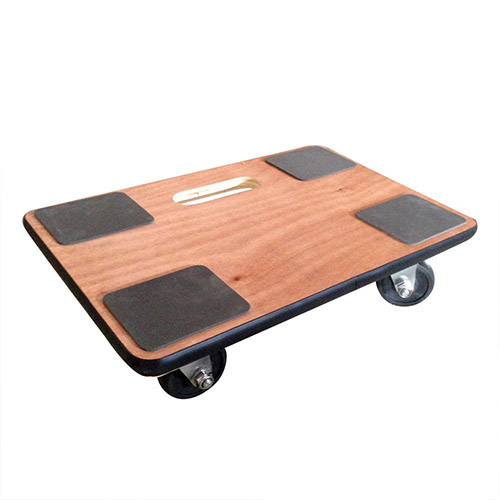
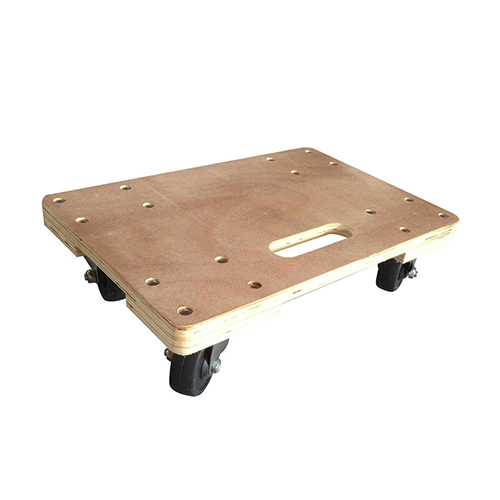
A plywood dolly uses an engineered plywood panel as its primary platform.
Plywood is manufactured from multiple thin wood veneers that are bonded together, typically with adjacent layers arranged in alternating grain directions. This cross-grain structure helps improve dimensional stability and reduces splitting tendencies compared with relying on one grain direction alone.
That construction makes plywood useful for flat platforms where consistent panel geometry is important.
Easemovo’s Plataforma rodante para madera contrachapada serie PWD combines a plywood platform with bump guards, non-slip pads, and four swivel wheels. It is positioned for applications including warehouses, offices, workshops, homes, furniture, appliances, and equipment handling.
Why Plywood Works Well as a Dolly Deck
Cross-laminated panel construction gives plywood useful dimensional consistency.
This can be beneficial when the design requires:
- A broad flat loading surface
- Multiple platform sizes
- Integrated non-slip surfaces
- Protective corner components
- Repeatable production dimensions
- Easy integration with caster mounting plates
However, plywood quality is not identical across all products. Veneer quality, thickness, adhesive system, panel grade, moisture exposure, mounting points, and overall design should all be considered.
Hardwood Dolly vs Plywood Dolly: Main Differences
The following comparison shows the practical differences that usually matter more than simply asking which wood is stronger.
| Selection Factor | Plataforma rodante de madera dura | Plataforma rodante de madera contrachapada |
|---|---|---|
| Deck construction | Solid hardwood components or deck | Multiple bonded veneer layers |
| Structural character | Rigid traditional wood construction | Engineered panel construction |
| Platform consistency | Depends on timber selection and construction | Generally consistent across the sheet |
| Surface options | Carpet, rubber, solid deck and other configurations | Anti-slip pads, coatings and bump guards can be integrated |
| Shape flexibility | Well suited to standard structural configurations | Easy to produce in multiple flat platform dimensions |
| Inspección | Wood members, joints and fasteners are generally visible | Panel edges, mounting points and surface condition should be checked |
| Moisture consideration | Depends on species and treatment | Depends strongly on plywood grade and adhesive system |
| Typical applications | Furniture, appliances, industrial loads, repeated moving | Cartons, furniture, equipment, warehouse and general moving |
| Main selection question | Is the hardwood structure appropriate for the load? | Is the plywood grade and platform design appropriate for the environment? |
Neither material should be selected from this table alone. Actual load ratings and operating conditions always take priority.
Is a Hardwood Dolly Stronger Than a Plywood Dolly?
Not necessarily.
This is one of the most important points when comparing hardwood dolly and plywood dolly designs.
The words “hardwood” and “plywood” describe materials, not the complete rated capacity of a moving dolly.
Rated Capacity Is a System Property
The usable load capacity of a dolly depends on several components working together:
Deck
The platform must resist bending, cracking, local deformation, and damage around mounting points.
Ruedas
Each caster has its own structural and rolling capability. Wheel material, diameter, bearing construction, and mounting method also affect handling.
Fasteners
Caster plates and other structural components must remain securely attached to the deck under repeated loading and vibration.
Load Position
A uniformly distributed load is different from a concentrated machine foot or a heavy object placed close to one edge.
Operating Surface
Smooth warehouse concrete creates different demands from thresholds, joints, ramps, uneven floors, or rough outdoor surfaces.
For this reason, selecting a hardwood dolly purely because hardwood sounds stronger can lead to the wrong conclusion.
A properly engineered plywood dolly may be better suited to one application, while a solid hardwood model may be more appropriate for another.
How Deck Construction Affects Heavy Load Handling
Heavy-load performance begins with understanding how force reaches the platform.
Distributed Loads
Boxes, cabinets, furniture bases, and large appliances may contact several areas of the deck.
A broad platform helps distribute these forces.
Concentrated Loads
Machine feet, narrow furniture legs, metal frames, and small containers can place much greater stress on a small deck area.
In these situations, platform stiffness and contact-point reinforcement become more important.
Uneven Loads
An object with most of its mass on one side changes the force placed on individual casters.
Operators should therefore avoid evaluating a dolly only by total load weight. Load shape and center of gravity are also important.
Hardwood vs Plywood: Which Is Better for Repeated Use?
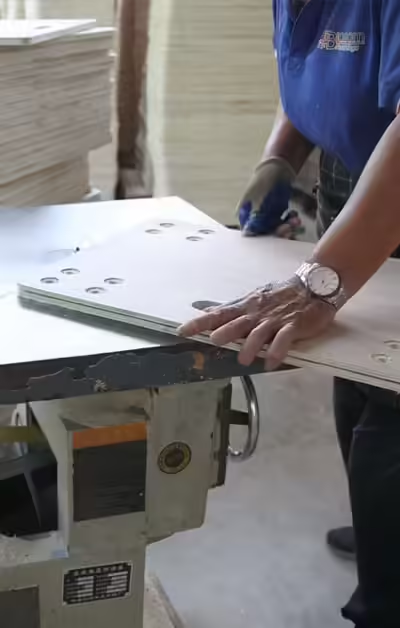
Repeated use introduces different stresses from occasional moving.
A dolly used several times per day may experience:
- Repeated starting and stopping
- Floor joints and thresholds
- Caster vibration
- Edge impacts
- Fastener movement
- Surface abrasion
- Load shifting
- Repeated turning
A hardwood dolly with a robust deck can be a strong option for repeated moving operations where structural rigidity and easy visual inspection are important.
A plywood dolly can also perform well in regular operations when the panel, caster mounting, thickness, surface treatment, and overall construction are selected for the required duty.
The better question is therefore not:
“Is hardwood or plywood more durable?”
It is:
“Which complete dolly construction is designed for my operating cycle?”
Caster Selection Can Matter More Than Deck Material
A strong deck with unsuitable wheels can still create a poor material handling system.
Caster diameter and wheel material influence:
- Starting force
- Rolling resistance
- Steering
- Noise
- floor protection
- Ability to cross joints or small obstacles
- Vibration transferred to the load
This is particularly important when moving heavy furniture and equipment.
Easemovo’s SHWD7646, for example, is configured with 3-inch hard polypropylene swivel casters, while its RHWD7646 hardwood rubber-end design uses 4-inch non-marring ball-bearing casters. These differences illustrate why two hardwood dollies can behave differently even though both use hardwood construction.
Readers comparing more general four-wheel configurations can also refer to Easemovo’s guide to choosing a 4 wheels dolly for warehouse moving, which discusses different dolly structures and warehouse scenarios.
How Surface Protection Changes the Decision
When transporting furniture or finished equipment, preventing scratches and movement can become more important than maximizing theoretical deck strength.
Carpet Contact Surfaces
Carpet-covered areas can provide a softer contact point for:
- Finished wood furniture
- Cabinets
- Tables
- Decorative components
- Painted items
Easemovo’s HWD7646 Plataforma rodante con extremo de alfombra de madera dura combines kiln-dried hardwood construction with carpeted contact areas and is specified on the current product page with a 1,000 lb load capacity.
For more information about this application, the existing Easemovo article ¿Muevas muebles pesados? Prueba una plataforma con alfombra. explains how carpeted surfaces can support furniture-moving applications.
Rubber Contact Surfaces
Rubber can add grip while providing a protective interface between cargo and deck.
This can be useful when the load has a smooth base or when reducing movement on the platform is important.
Anti-Slip Plywood Surfaces
Plywood platforms can also incorporate anti-slip treatments.
El FPWD7050 Plataforma rodante antideslizante uses a plywood deck together with an anti-slip surface and galvanized steel brakes, showing how safety and control features can be integrated into a plywood-based design.
Hardwood Dolly or Plywood Dolly for Warehouses?
Both can be appropriate.
For warehouse operations, first define the actual task.
Choose Based on Cargo
A hardwood dolly may be particularly useful for repeated furniture, appliance, equipment, or heavy-item movement where rigid wooden construction and protected contact points are desirable.
A plywood dolly may suit general warehouse movement where a broad platform, different deck dimensions, non-slip surfaces, or corner protection are priorities.
Choose Based on Travel Path
Before specifying the deck, inspect:
- Floor smoothness
- Expansion joints
- Thresholds
- Ramp gradients
- Turning space
- Travel distance
- Floor contamination
- Indoor or outdoor exposure
Wheel selection may need to change even when the deck remains the same.
Choose Based on Handling Frequency
A dolly used occasionally has different lifecycle demands from one used throughout a warehouse shift.
Higher-frequency operations justify closer attention to caster bearings, wheel wear, fastener inspection, deck condition, and replaceable components.
Pushing, Pulling and Material Handling Safety
Equipment selection also affects ergonomics.
The U.S. Occupational Safety and Health Administration explains in its materials handling guidance on pushing and pulling that pushing is generally preferable to pulling when possible because body weight can assist the exertion, while pulling may introduce additional handling risks.
For a low-profile dolly without an integrated handle, users should plan movement carefully rather than improvising unsuitable pushing or pulling techniques.
Where frequent directional control is required, a dedicated Manillar de plataforma móvil or another trolley-style configuration may be more appropriate than a basic flat platform.
The equipment should match both the cargo and the way operators actually move it.
When Should You Choose a Hardwood Dolly?
A hardwood dolly is worth considering when:
- A rigid wooden structure is preferred
- Heavy furniture or appliances are moved regularly
- A solid or rail-style hardwood design matches the load geometry
- Carpet or rubber protective surfaces are needed
- The deck and joints need to be easy to inspect
- The available model has an appropriate verified load rating
- The caster configuration matches the floor
For buyers evaluating different hardwood constructions, Easemovo’s Hard Wood Dolly range includes solid-deck, rubber-end, and carpet-contact configurations for different moving requirements.
When Should You Choose a Plywood Dolly?
A plywood dolly may be a better fit when:
- A broad engineered panel is preferred
- Multiple platform sizes are required
- Anti-slip pads or coatings are important
- Protective corner bumpers are useful
- General warehouse, office, workshop, or moving applications dominate
- A relatively simple flat platform is desired
- The selected plywood grade suits the operating environment
Easemovo’s Normal Moving Dolly range includes plywood-platform designs equipped with swivel wheels for general material handling applications.
You can also review the existing Top 7 Best Moving Dolly Options guide for examples of different platform and caster combinations, including the FPWD7050 anti-slip plywood model.
A Practical Selection Checklist
Before choosing either design, confirm these specifications:
| Question | Why It Matters |
| What is the maximum actual load? | Establishes the minimum rated capacity |
| Is the load evenly distributed? | Concentrated loads can create local deck stress |
| What are the load dimensions? | Determines required deck size |
| Does the cargo need surface protection? | May require carpet, rubber or anti-slip contact areas |
| What floor will the dolly operate on? | Influences wheel material and diameter |
| Are thresholds or joints present? | Small wheels may be harder to move across obstacles |
| How frequently will it be used? | Influences durability and maintenance requirements |
| Is precise steering important? | Determines caster and handle configuration |
| Is moisture exposure expected? | Affects wood and plywood specification |
| Are custom dimensions required? | May justify a customized material handling solution |
This checklist is usually more useful than comparing hardwood and plywood in isolation.
Can a Dolly Be Customized for a Specific Application?

Yes. Standard dollies are useful when common platform dimensions, caster arrangements, and load ratings fit the application, but not every material handling task fits a standard configuration.
Applications may require different:
- Deck dimensions
- Caster diameters
- Wheel materials
- Surface protection
- Mangos
- Sistemas de frenado
- Load capacities
- Platform materials
- Anti-slip treatments
- Packaging or branding requirements
For projects where a standard hardwood dolly or plywood dolly does not match the operating conditions, Easemovo’s Custom Material Handling Equipment solutions provide another route for matching the equipment specification to the application.
Hardwood Dolly vs Plywood Dolly: Final Recommendation
There is no universal winner between a hardwood dolly and a plywood dolly.
Choose a hardwood dolly when the available model provides the rigid construction, protective surface, caster setup, and verified capacity required for the task.
Choose a plywood dolly when an engineered flat platform, configurable dimensions, anti-slip features, or general-purpose handling characteristics better match the application.
Most importantly, compare complete specifications rather than deck names.
A reliable selection process should consider:
- Rated load
- Load distribution
- Platform dimensions
- Deck construction
- Caster size
- Wheel material
- Surface protection
- Floor conditions
- Travel distance
- Handling frequency
- Required maneuverability
The deck is only the foundation. The best moving dolly is the one whose complete system matches the actual load and operating environment.
Preguntas frecuentes
Is a hardwood dolly better than a plywood dolly for heavy furniture?
A hardwood dolly can be an excellent option for heavy furniture when its rated capacity, deck dimensions, caster configuration, and protective surfaces match the load. However, hardwood alone does not guarantee greater capacity. A properly engineered plywood dolly may also handle demanding loads effectively, so always compare complete specifications.
How much weight can a hardwood dolly carry?
Capacity varies by model and should never be assumed from the material alone. For example, Easemovo currently specifies its SHWD7646 Solid Deck Hardwood Dolly for loads up to 1,000 lb. Other models may have different ratings because deck construction, fasteners, caster capacity, dimensions, and structural design all influence the final limit.
Is plywood strong enough for a moving dolly?
Yes, when the plywood grade, thickness, construction, caster mounting, and complete dolly design are suitable for the intended load. Plywood uses bonded veneer layers with alternating grain directions, giving the panel useful dimensional stability. The actual dolly rating should still be checked instead of assuming capacity from the deck material.
Which dolly deck is better for protecting furniture?
Surface treatment matters more than the basic deck name. Hardwood dollies can use carpet or rubber contact areas, while plywood designs can incorporate non-slip pads and protective bump guards. For finished furniture, evaluate where the item contacts the platform and select a surface that reduces scratching, sliding, and impact.
What should I check before ordering a hardwood or plywood dolly?
Confirm the load weight, dimensions, center of gravity, deck size, rated capacity, caster diameter, wheel material, floor condition, travel distance, operating frequency, and required surface protection. For commercial applications, also consider maintenance access, spare components, packaging, and whether custom dimensions or caster configurations are required.
 Spanish
  English
  French
  Japanese
  German