

Inhaltsverzeichnis
Einführung
Moving heavy furniture, appliances, cartons, machinery components, or bulky equipment is rarely just a question of whether a dolly can support the stated weight. The real challenge is controlling the load, protecting its surface, maintaining stable movement, and reducing the effort required from the operator.
A well-designed carpet dolly addresses several of these requirements at once. The carpet-covered contact surface helps reduce direct contact between the load and the supporting frame, while a low-profile platform and four-wheel configuration can make large objects easier to position and transport.
For warehouses, furniture distributors, moving companies, retailers, workshops, and industrial facilities, choosing the right carpet dolly therefore requires more than comparing price or maximum load capacity.
This guide explains how to evaluate platform construction, carpet coverage, load size, caster configuration, wheel material, floor conditions, maneuverability, and customization requirements before selecting a carpet dolly for repeated commercial use.
What Is a Carpet Dolly?

A carpet dolly is a compact wheeled material handling platform with a carpeted or cushioned contact surface designed to support furniture, appliances, cartons, equipment, and other bulky objects during short-distance transportation.
Unlike a traditional hand truck, which normally requires the load to be tilted against a vertical frame, most carpet dollies keep the cargo close to the floor. This low-profile configuration can make loading easier and helps keep the center of gravity relatively low.
The carpeted surface performs an important secondary function. When painted furniture, wooden cabinets, appliances, display fixtures, office equipment, or finished components are placed directly on an exposed metal or wood platform, movement can create scratches or marks. A carpet-covered deck introduces a softer interface between the dolly and the cargo.
Easemovo’s RPWD7050-Ⅲ Rollwagen mit Teppichboden is one example of this design. It combines a carpeted platform with a ribbed rubber top, rounded edges, a hand-hold and 100 mm rubber swivel casters for handling bulky loads.
Why Carpeted Dollies Are Used for Heavy and Bulky Loads
The word “heavy” can be misleading when selecting material handling equipment.
Two objects may weigh exactly the same but behave very differently during transportation. A compact steel component places its weight over a relatively small area, while a long cabinet or appliance may extend beyond the platform and create different balance requirements.
This is why carpet moving dollies are frequently selected for objects that are not simply heavy, but also bulky, finished, awkwardly shaped, or vulnerable to cosmetic damage.
Common examples include:
- Furniture and cabinets
- Sofas and benches
- Household and commercial appliances
- Office equipment
- Display fixtures
- Crated products
- Workshop equipment
- Finished wooden components
- Boxes and packaged goods
- Maintenance equipment
For these applications, cargo support, surface protection and stable rolling can be just as important as maximum load rating.
Start With the Actual Load, Not the Dolly
Before comparing carpet dollies, define exactly what will be moved.
A purchasing specification should ideally include the maximum expected weight, typical dimensions, shape of the load, frequency of movement, travel distance, floor condition, doorway width and whether the load has a delicate finished surface.
This provides a much more useful basis for selection than simply asking for a “heavy duty carpet dolly.”
For example, a 200 kg rectangular machine enclosure with a stable base creates a different handling problem from a 100 kg tall cabinet with a narrow contact area. The second load may technically be lighter while being more difficult to stabilize.
The buyer should therefore consider three questions together:
Can the platform support the weight?
Can the deck properly support the dimensions of the object?
Can the operator control the loaded dolly throughout the entire route?
If one of these conditions is not satisfied, choosing a higher load rating alone may not solve the problem.
Carpet Dolly Load Capacity: How Much Do You Really Need?
Load capacity should always be treated as a working limit rather than a target that operators should routinely exceed.
The selected dolly should comfortably accommodate the heaviest expected load under the actual operating conditions. Warehouses should also account for occasional variations in product weight, packaging, uneven loading and repeated daily use.
A useful purchasing approach is to separate the application into three categories.
| Application | Typical Requirement | Main Selection Concern |
|---|---|---|
| Light commercial handling | Boxes, small furniture, office items | Mobility and compact storage |
| Medium-duty handling | Cabinets, appliances, equipment | Platform stability and caster quality |
| Heavy commercial handling | Dense equipment and large furniture | Structural strength, wheels and load control |
The manufacturer’s rated capacity is important, but it should not be evaluated independently from caster specifications, platform dimensions and floor conditions.
A dolly may have a strong deck, for example, but difficult floor transitions or undersized wheels can dramatically increase the force required to start or steer the loaded equipment.
The U.S. Occupational Safety and Health Administration recommends balancing loads, remaining within manufacturer weight restrictions and using wheels suited to the facility’s floor surface when using manually moved carts and similar material handling devices.
Choose the Right Platform Size
Platform dimensions determine how well a carpet dolly supports the object placed on it.
A platform that is unnecessarily large may reduce maneuverability in narrow aisles. A platform that is too small may leave excessive overhang and make the load harder to balance.
When evaluating platform size, measure the contact points of the objects that will normally be carried rather than only their overall dimensions.
A sofa, for example, may be physically much longer than the dolly but still rest securely on a compact platform if the correct support points are used. By contrast, a machine with a narrow but uneven base may require a larger contact area even if its external dimensions are smaller.
Buyers should evaluate:
- Width of the load
- Length of the supporting surface
- Position of the center of gravity
- Allowable cargo overhang
- Doorway dimensions
- Elevator dimensions
- Warehouse aisle width
- Storage requirements when the dolly is not in use
Easemovo’s carpeted moving dolly has a 70 × 50 cm body and a low-profile configuration intended to provide a useful balance between cargo support and maneuverability.
Carpet Coverage Is More Important Than It Looks
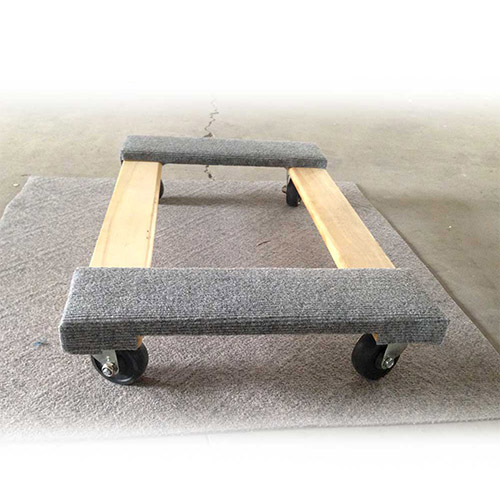
The carpet is not merely decorative.
Its role is to create a protective layer between the dolly structure and the object being transported. For furniture, painted equipment, wooden products and finished assemblies, this can help reduce direct abrasive contact.
However, buyers should examine how the carpet is applied.
Important considerations include coverage around the deck, exposed fasteners, edge protection, durability of the carpet material and whether additional rubber or anti-slip elements are incorporated into the design.
A carpeted furniture dolly intended for frequent commercial operation should also be easy to inspect. Torn carpet, exposed staples, trapped debris or damaged padding can eventually create the very surface damage the covering was intended to prevent.
Regular inspection and cleaning should therefore be part of the handling equipment maintenance routine.
For especially slippery products or operations where additional grip is required, buyers can also compare carpeted designs with anti-slip moving dollies.
Wheel Material Can Change the Entire Handling Experience
Caster selection is one of the most underestimated parts of buying a carpet dolly.
The same platform can feel completely different depending on wheel diameter, tread material, bearing quality and caster arrangement.
A buyer should never select wheels without considering the floor.
Smooth warehouse concrete, painted industrial floors, tile, wood, loading areas and rough outdoor surfaces create different rolling requirements.
OSHA guidance notes that wheels should be selected for the floor surface and that larger wheels are generally easier to push. It also notes that solid hard wheels may suit hard surfaces, while pneumatic wheels can perform better on rough or uneven surfaces.
For typical carpet dollies, common wheel considerations include:
Gummiräder
Rubber wheels can provide relatively quiet operation and are often suitable where floor protection and controlled movement are important.
They may be appropriate for furniture stores, offices, warehouses and indoor commercial environments.
Polyurethanräder
Polyurethane casters are frequently selected for industrial applications requiring durability, relatively low rolling resistance and resistance to many floor conditions.
The exact performance depends on wheel hardness, diameter and construction.
Hard Plastic or Polypropylene Wheels
Hard wheels can roll efficiently on smooth, hard surfaces but may transmit more vibration and noise than softer alternatives.
They may also be less suitable where the flooring itself requires greater protection.
Pneumatic Wheels
Pneumatic or similar resilient wheel designs can provide advantages over uneven ground, but they normally create a different overall product configuration from a compact indoor carpet dolly.
The correct choice therefore depends on whether the equipment operates primarily inside a warehouse or must regularly cross rough external surfaces.
Wheel Diameter Matters Too
Increasing wheel diameter generally improves the ability of a dolly to pass over small floor irregularities, thresholds, joints and minor debris.
Smaller casters help maintain a low platform height and compact overall design, but they may require more effort when floor conditions are poor.
This creates a practical design trade-off.
A warehouse with smooth epoxy-coated floors may prioritize a compact low-profile dolly. A facility with expansion joints, damaged concrete or frequent transitions between surfaces may benefit more from larger casters.
Easemovo’s RPWD7050-Ⅲ Rollwagen mit Teppichboden uses 100 mm rubber swivel casters, illustrating a configuration designed to combine maneuverability with practical indoor material handling.
Four Swivel Casters or Fixed and Swivel Wheels?
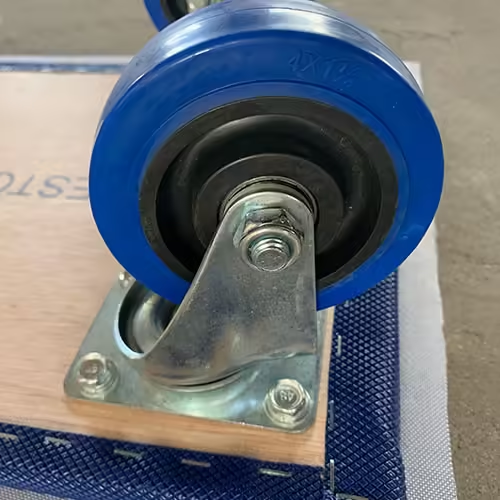
A typical 4 wheel carpet dolly often uses four swivel casters.
This configuration provides excellent maneuverability because the dolly can move in multiple directions and rotate within a relatively small area.
That can be valuable when repositioning furniture, aligning equipment or operating inside stockrooms and narrow warehouse spaces.
However, maximum maneuverability is not always the same as maximum directional stability.
For carts that repeatedly travel long straight routes, a combination of fixed and swivel casters may make steering more predictable.
OSHA material handling guidance similarly notes that swivel rear wheels combined with fixed front wheels can improve pushing and steering on longer carts, while designs with more swivel capability can improve maneuverability in tighter areas.
For this reason, caster arrangement should match the actual travel route rather than simply following the most common design.
Check the Floor Before Choosing a Heavy Duty Carpet Dolly
Floor condition has a direct effect on rolling resistance.
Even an excellent carpet dolly can become difficult to control if its caster system does not match the operating surface.
Before ordering commercial dollies, examine the complete handling route.
Look for:
- Floor cracks
- Expansion joints
- Door thresholds
- Elevator gaps
- Slopes
- Drain channels
- Rough concrete
- Metal plates
- Debris
- Wet or contaminated areas
OSHA identifies equipment maintenance and floor surface condition as factors that can significantly increase the force required when pushing or pulling carts.
This means a warehouse buying decision should consider the route from pickup to destination, not just the floor immediately around the loading point.
Protecting Furniture and Finished Surfaces
One of the biggest advantages of a carpet dolly is cargo protection.
Finished furniture and equipment can be expensive even when they are not particularly heavy. A scratch, dent or chipped edge may create a greater financial loss than the cost of the dolly itself.
A good carpeted dolly should therefore minimize hard contact points around the loading surface.
Rounded platform edges, carpet wrapping, rubber surfaces and protective corners can all contribute to reducing accidental damage.
For example, Easemovo’s carpeted moving dolly incorporates rounded corners, bevelled edges and a carpeted platform with an additional ribbed rubber surface.
Businesses handling especially sensitive loads should evaluate the dolly and cargo together. In some cases, protective blankets, straps, corner protectors or custom supports may still be required.
Think About Load Stability Before Movement
A carpet surface can improve protection, but it should not be assumed to secure every load automatically.
Tall, narrow or irregular objects may still shift when the dolly accelerates, turns or stops.
Before moving the load, operators should verify that its center of gravity remains within a stable area over the platform.
Loads should also be balanced instead of placing most of the weight near one edge.
Where appropriate, straps or other restraint systems may be necessary.
Stack height deserves particular attention. OSHA advises that loads on carts should not obstruct the operator’s vision and recommends maintaining good visibility over the load.
This is especially relevant when carpet dollies are used for boxes, stacked cartons or tall furniture.
Push, Pull and Operator Safety
Buying the correct dolly does not eliminate the importance of correct handling practices.
Starting a loaded dolly from rest, changing direction and stopping it can require significant force, particularly when the load is heavy or the floor is uneven.
Where the product configuration allows it, pushing is generally preferable to pulling. OSHA ergonomics guidance recommends using carts for horizontal movement where possible and notes that pushing is generally preferable to pulling when handling wheeled equipment.
For applications requiring more directional control, Easemovo also offers handle moving dollies that provide a dedicated handle configuration.
The correct solution depends on the load and route. Compact four-swivel carpet dollies may be ideal for positioning furniture in tight spaces, while handled equipment may be more appropriate where workers repeatedly move loads over longer routes.
Carpet Dolly vs Standard Moving Dolly
A carpet dolly and a standard moving dolly can have very similar basic structures, but their preferred applications may differ.
| Besonderheit | Teppichwagen | Standard Moving Dolly |
| Surface protection | High priority | Depends on deck design |
| Furniture handling | Exzellent | Gut |
| Finished appliances | Exzellent | Depends on protection |
| Boxes and cartons | Gut | Exzellent |
| Industrial components | Application dependent | Exzellent |
| Surface grip | Depends on carpet/rubber design | Depends on anti-slip pads |
| Easy cleaning | Mäßig | Often easier |
| Cosmetic load protection | Major advantage | Design dependent |
For mixed warehouse applications, companies may benefit from maintaining several types of dollies rather than attempting to use one platform for every product.
Easemovo’s broader normal moving dolly range includes different platform structures for buyers who need alternatives to carpet-covered designs.
Carpet Dolly vs Hardwood Dolly
Carpet dollies prioritize protected contact with the cargo, while exposed hardwood designs can emphasize structural simplicity and durability.
Neither is automatically better.
The decision depends on what is being moved.
For finished furniture, decorative fixtures and appliances, carpet coverage can be extremely useful. For dense industrial items where surface protection is less important, a solid deck or alternative structure may make more sense.
Businesses comparing deck construction can also review Easemovo’s guide to Hardwood Dolly vs Plywood Dolly for a deeper look at how material and construction influence handling performance.
What Commercial Buyers Should Check Before Ordering
For distributors, importers, warehouse operators and professional moving companies, product selection should go beyond a website photo.
Before placing a bulk order, confirm the technical specification.
A practical purchasing checklist should include:
- Rated load capacity
- Platform dimensions
- Total product height
- Caster diameter
- Wheel tread material
- Caster bearing type
- Swivel or fixed configuration
- Deck material
- Carpet material and coverage
- Anti-slip elements
- Edge protection
- Carrying handle or hand-hole
- Net product weight
- Packaging method
- Replacement caster availability
- Quality inspection method
- OEM or ODM options
These details help buyers compare products based on actual operating requirements rather than appearance alone.
When Should You Consider a Custom Carpet Dolly?
Standard carpet dollies work well for many furniture and warehouse applications, but some operations have more specific requirements.
Customization may be worthwhile when a business repeatedly handles the same unusual load or needs equipment to fit a defined warehouse process.
Typical customization requirements include:
Different Platform Dimensions
A custom deck can provide better support for long, wide or unusually shaped cargo.
Higher Load Capacity
Structural components and caster specifications may need to change when loads exceed the capacity of a standard model.
Different Caster Materials
Floor protection, noise, rolling resistance, chemical exposure and surface condition can influence the choice of caster.
Branding and Color
Distributors and private-label buyers may require product colors, labels, packaging or logos that match their own brand.
Special Surface Protection
Different carpet, rubber or anti-slip materials may be required for delicate or unusual cargo.
Easemovo provides custom material handling equipment solutions covering product design, material selection, dimensional changes, functional customization and OEM/ODM manufacturing.
For high-volume buyers, defining these requirements before sampling can significantly improve the efficiency of product development.
How to Evaluate a Carpet Dolly Manufacturer

For B2B buyers, the dolly itself is only one part of the purchasing decision.
A reliable manufacturer should be capable of controlling production consistency across larger orders.
Important factors include engineering support, material sourcing, caster quality, welding or fastening consistency, load testing, quality inspection, packaging and the ability to develop customized models.
Easemovo is operated by Qingdao Kinkayo Industry and Trade Co., Ltd., a material handling equipment manufacturer established in 1998. Its current product portfolio includes moving dollies, hardwood dollies, anti-slip dollies, handle dollies, wagons, trolleys and other material handling solutions. The company also supports OEM and ODM development for customers requiring customized equipment.
Buyers sourcing for distribution, retail or industrial projects can learn more about Easemovo’s material handling equipment manufacturing capabilities.
Common Carpet Dolly Selection Mistakes
One of the most common mistakes is selecting a dolly entirely by maximum load rating.
A high capacity does not automatically guarantee easy movement.
Another mistake is ignoring wheel material. A caster that performs well on one warehouse floor may create excess noise, resistance or marking on another.
Buyers also frequently underestimate platform dimensions. A technically strong dolly may still be unsuitable if the cargo cannot sit securely on the supporting surface.
Other avoidable mistakes include using damaged carpet, exceeding the rated capacity, stacking cargo too high, ignoring caster maintenance and continuing to use wheels that no longer rotate freely.
OSHA notes that well-maintained carts require less force to move and recommends maintaining wheels and keeping travel areas clear of debris.
For commercial operations, routine inspection should therefore be considered part of the product’s operating cost.
Häufig gestellte Fragen
What is a carpet dolly used for?
A carpet dolly is primarily used to move furniture, appliances, boxes, equipment and bulky objects while providing a softer contact surface that can help protect finished cargo from scratches and direct abrasion.
Is a carpet dolly suitable for heavy furniture?
Yes, provided that the selected model has adequate load capacity, suitable platform dimensions and appropriate casters for the operating surface. Buyers should always follow the manufacturer’s rated load limit.
Are carpet dollies good for hardwood floors?
They can be, but the carpet itself does not determine floor compatibility. The caster tread is the part that contacts the floor, so buyers should select wheel material appropriate for sensitive flooring.
What size carpet dolly should I buy?
The best platform size depends on the contact area and center of gravity of the objects being transported. The platform should provide stable support without making the dolly unnecessarily difficult to maneuver through doors and aisles.
Are four swivel wheels better?
Four swivel casters provide excellent multidirectional maneuverability and can be useful in tight indoor spaces. Fixed and swivel combinations may provide better directional control on longer straight routes.
What is the difference between a carpet dolly and furniture dolly?
The terms are sometimes used interchangeably. A furniture dolly normally describes the application, while carpet dolly emphasizes the protected carpet-covered contact surface. Many commercial products satisfy both descriptions.
Can carpet dollies be customized?
Yes. Depending on the manufacturer, dimensions, platform materials, carpet coverage, caster type, load capacity, color, branding and packaging can potentially be customized for commercial orders.
How often should dolly wheels be inspected?
Inspection frequency should reflect how intensively the equipment is used. High-use warehouse dollies should be checked regularly for wheel wear, damaged bearings, loose fasteners, trapped debris and reduced swivel performance.
Abschluss
Choosing a carpet dolly for heavy loads requires more than finding the strongest-looking platform.
The best product is the one that matches the actual load, supporting area, floor condition, handling route and frequency of use. Load capacity determines whether the structure can carry the object, but platform dimensions influence stability, carpet coverage helps protect finished surfaces, and caster design determines how easily the loaded dolly can actually move.
For commercial buyers, these factors should be evaluated as a complete material handling system.
A warehouse handling furniture may prioritize carpet protection and maneuverability. An industrial facility may focus more heavily on wheel durability and load capacity. A distributor may need standardized packaging, private labeling and consistent production across large orders.
Easemovo supplies carpeted moving dollies, normal moving dollies, handle moving dollies and customized material handling equipment for different commercial applications.
If your project requires a specific platform dimension, load capacity, caster configuration or OEM/ODM design, you can contact Easemovo to discuss a customized material handling solution.
 German
  English
  French
  Japanese
  Spanish